Rad Power Bikes Review 2026: RadRover, RadRunner, RadCity Compared
We may earn a commission on qualifying purchases through links on this page, at no extra cost to you. Our recommendations are based on independent research — manufacturer specifications, independent lab data, and aggregated owner reports — not on commission rates.
Our Verdict
Rad Power Bikes
Rad Power Bikes is the original direct-to-consumer e-bike brand — 650,000+ bikes sold since 2007, a 30-day test ride policy that no competitor matches, and a lineup focused on actual utility (cargo, commuting, fat tire) rather than aesthetics.
Best for
- Utility-focused riders who haul or commute
- Buyers who want a 30-day test ride
- California homeowners replacing a second car
Not ideal for
- Apartment dwellers (most Rads are 70+ lbs)
- Riders who want mid-drive performance
Free shipping • Price verified today
Rad Power Bikes invented the direct-to-consumer e-bike category in North America. Founded in Seattle in 2007 by Mike Radenbaugh — who rebuilt a stranded e-bike on the side of a road as a 15-year-old; the company has shipped more than 650,000 bikes and captured the largest share of the U.S. E-bike market by volume. If you know one e-bike brand name, it's probably Rad.
The 2026 lineup is deeper than it's ever been: a fat-tire rugged commuter (RadRover 6 Plus), a utility runabout (RadRunner 3 Plus), a step-through city commuter (RadCity 5 Plus), a folding apartment bike (RadExpand 5), a family cargo hauler (RadWagon 5), and a three-wheel stability bike (RadTrike). This guide walks through the full lineup, who each bike is for, and where Rad genuinely beats the competition vs where it's been caught up.
Rad Power Bikes Lineup Comparison
| Feature | Most PopularRadRover 6 Plus★ 4.6/5 | Utility PickRadRunner 3 Plus★ 4.5/5 | Best CommuterRadCity 5 Plus★ 4.6/5 | Folding PickRadExpand 5★ 4.4/5 | Family HaulerRadWagon 5★ 4.5/5 | Stability PickRadTrike★ 4.4/5 |
|---|---|---|---|---|---|---|
| Motor | 750W hub (80 Nm) | 750W hub | 750W hub | 750W hub | 750W hub | 750W hub |
| Top Speed | 20 mph | 20 mph | 20 mph | 20 mph | 20 mph | 14 mph |
| Range | 25-45 mi | 25-45 mi | 25-50 mi | 25-45 mi | 25-55 mi | 25-40 mi |
| Weight | 74 lbs | 73 lbs | 65 lbs | 62 lbs | 78 lbs | 82 lbs |
| Best For | Fat tire / all-terrain | Utility / passenger | Daily commuting | Apartments / RVs | Cargo / kids | Mobility / balance |
| Price | $1,999 | $2,299 | $1,999 | $1,499 | $2,299 | $2,499 |
| Check Price |
Prices and specs verified October 2026. Click through for current pricing and availability.
Rad Power Brand Story: The Company That Started the Movement
Rad Power Bikes was founded in 2007 in rural Northern California by Mike Radenbaugh. The company moved to Seattle in 2015 and scaled rapidly during the 2020-2022 e-bike boom, raising $150M in venture capital and becoming the largest DTC e-bike brand in North America. In 2022-2023, Rad downsized from a peak of 600+ employees to focus on profitability and shifted strategy toward supporting the existing fleet rather than launching new frames every quarter.
What this means for buyers in 2026:
- Mature parts availability — replacement batteries, motors, controllers, and accessories are all readily available for every current and recent-past model
- Physical Rad Experience Centers in San Francisco, Seattle, San Diego, Los Angeles, Denver, and other cities where you can test-ride
- Expanding dealer network — local bike shops that service Rad bikes are easier to find than for newer DTC brands
- Slower innovation cycle — don't expect frame redesigns every year; Rad is iterating on its proven platform instead
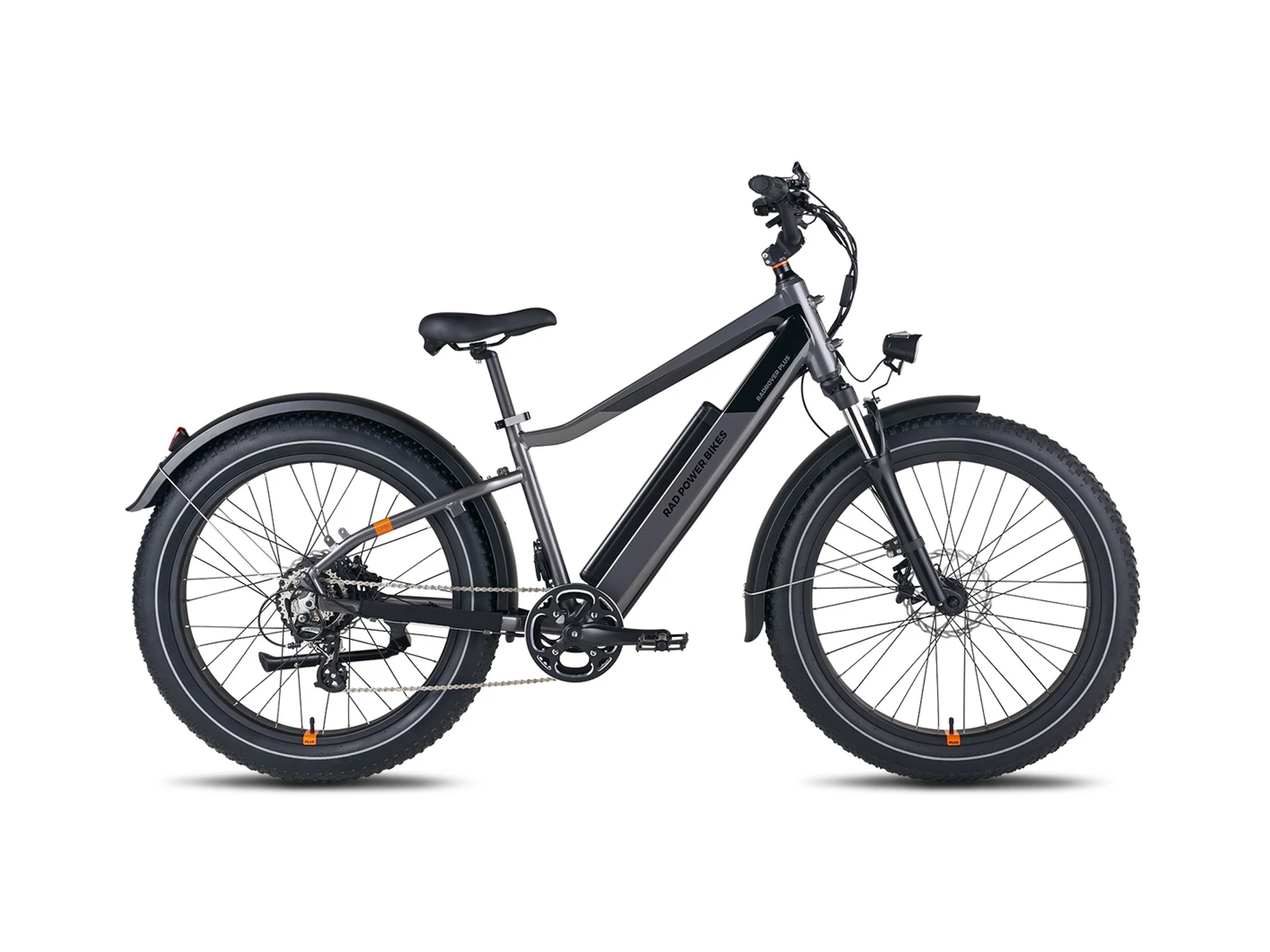
1. RadRover 6 Plus, The Fat-Tire Flagship
Price: $1,999 · Motor: 750W geared hub (80 Nm) · Range: 25-45 mi · Weight: 74 lbs · Tires: 26 x 4 inches
The RadRover is Rad's best-selling bike and the one most people think of when they say "a Rad." Version 6 Plus is the current generation, released in 2022 and still on sale in 2026 with minor refinements. It's built around a massive 26 x 4-inch fat tire that floats over everything. pavement, dirt roads, packed snow, loose gravel, wooden docks; and a 750W geared hub motor rated for 80 Nm of torque.
Real-world performance: Comfortable cruising at 18-20 mph on pavement, confidence-inspiring grip on loose surfaces, and genuine off-road capability on fire roads and easier trails. The torque is enough to pull a 220-pound rider plus a loaded cargo rack up 12-15% grades without the motor getting hot. The 672 Wh semi-integrated battery delivers 25-30 miles at aggressive pace or 40-45 miles at easy cruise.
The weaknesses: fat tires create serious rolling resistance on smooth pavement (you're fighting about 15% more drag than a 2-inch commuter tire), the bike is 74 lbs which is tough to hoist on a rack, and the cadence-sensor pedal assist feels less natural than the torque-sensor bikes from Aventon or Trek. For the price, it's still the best fat-tire e-bike in the U.S. market by a wide margin.
2. RadRunner 3 Plus, The Swiss Army Knife
Price: $2,299 · Motor: 750W geared hub · Range: 25-45 mi · Weight: 73 lbs · Cargo capacity: 350 lbs total
The RadRunner is one of the most distinctive-looking bikes on the market — a moped-style silhouette with 20 x 3.3-inch tires, a long integrated rear rack that doubles as a passenger seat, and a step-through frame that makes mounting the bike easy. It's Rad's most configurable model, with modular accessories for a child seat, passenger seat, large cargo baskets, and running boards.
Real-world use: this is the bike for running errands, hauling kids to school, picking up groceries without a car, and short-distance delivery work. The rear rack supports a full adult passenger on the "Passenger Package" accessory. Two kids in 48-52 lb bike seats fit comfortably with room for groceries on top. For a California family that wants to reduce second-car usage, the RadRunner is the closest thing to a car replacement in the Rad lineup outside the RadWagon.
3. RadCity 5 Plus — The Daily Commuter
Price: $1,999 · Motor: 750W geared hub · Range: 25-50 mi · Weight: 65 lbs · Tires: 27.5 x 2.4 inches
The RadCity is what most traditional e-bike shoppers are actually looking for: a step-through commuter with 27.5-inch hybrid tires, integrated lights, full fenders, a rear rack, and a torque-sensor pedal assist that feels closer to a Trek or Specialized than to the cadence-sensor Rads below it. At 65 lbs, it's the lightest bike in the standard Rad lineup.
The torque sensor is the story here. Unlike the RadRover or RadRunner, the RadCity 5 Plus measures how hard you're pushing on the pedals and delivers proportional assistance. The result is a bike that feels more like pedaling a regular bicycle with a tailwind, you're clearly contributing, and the motor amplifies your effort linearly instead of kicking in with a binary on/off sensation.
For a daily-use commuter who wants something that rides like a bike but goes further and faster without sweating, the RadCity 5 Plus is the right Rad to buy.
Why Rad Wins on Utility
If you need a bike that hauls cargo, carries a passenger, or gets you to work reliably through all conditions, the Rad lineup is still the deepest utility e-bike catalog in North America.
4. RadExpand 5, The Folding Apartment Bike
Price: $1,499 · Motor: 750W geared hub · Range: 25-45 mi · Weight: 62 lbs · Folded size: 41 x 21 x 28 inches
The RadExpand 5 is Rad's answer to the Lectric XP 3.0 — a folding fat-tire e-bike at $1,499 (vs $999 for the Lectric). At 62 lbs, it's lighter than the XP 3.0 (65 lbs) but $500 more expensive. What you get for the premium: the Rad support network, 30-day test ride, and slightly better build quality in the frame welds and cable routing.
For apartment dwellers who want to store the bike indoors, RV owners who need to bring a bike along on trips, or anyone who has to carry the bike through tight spaces, the RadExpand 5 is a capable pick. If the $500 price difference matters, the Lectric XP 3.0 wins on value; if brand support and test-rideability matter more, the RadExpand wins on peace of mind.
5. RadWagon 5 — The Family Cargo Bike
Price: $2,299 · Motor: 750W geared hub · Range: 25-55 mi · Weight: 78 lbs · Total capacity: 450 lbs
The RadWagon 5 is Rad's flagship cargo bike, a longtail design with a 70-inch wheelbase, 24-inch wheels (for a lower center of gravity), a massive rear rack rated for 120 lbs of cargo, and dual-kickstand parking. It fits two child seats side-by-side, includes running boards that double as footrests for kids, and has safety features like wheel skirts to keep small feet out of the spokes.
Real-world: families using the RadWagon 5 as a second-car replacement report typical errand loops of 15-25 miles round trip (school drop-off + grocery run + pickup) with the bike running entirely on Class 2 throttle when needed. The 672 Wh battery delivers that comfortably with range to spare. For longer trips, the dual-battery upgrade ($500) pushes range past 90 miles.
The weaknesses: at 78 lbs before cargo, the RadWagon is heavy enough that you really feel it when the battery dies mid-ride. The rear rack is tall, which raises the center of gravity when loaded. Competitors like the Tern GSD ride more precisely but cost $3,000 more.
6. RadTrike. The Stability Pick
Price: $2,499 · Motor: 750W geared hub · Range: 25-40 mi · Weight: 82 lbs · Top speed: 14 mph
The RadTrike is Rad's three-wheel e-bike, designed for riders who have balance concerns, mobility limitations, or just want the stability of a tricycle for hauling cargo. The front-wheel-drive (single front, two rear) layout is a true tricycle with a differential that allows the rear wheels to rotate at different speeds during turns — no weird tipping behavior.
The large rear cargo basket (20 x 28 inches) is the standout feature. This is the bike for farmer's market runs, mobility-limited riders who want to keep riding, and seniors who have given up on two-wheel bikes but still want outdoor activity. Top speed is limited to 14 mph for safety. Turn radius is larger than a traditional bike, but not hostile.
Warranty Policy: Rad's Standout Advantage
Rad Power Bikes offers a 1-year comprehensive warranty covering the motor, battery, controller, display, and components, plus an additional 2 years on the frame (3 years total frame warranty). The battery warranty is 1 year regardless of charge cycles — shorter than Lectric's 800-cycle spec but simpler to understand and make claims against.
The standout feature is the 30-day test ride. Buy a Rad, ride it for up to 30 days, and if it isn't the right fit you can return it for a full refund (you pay return shipping, roughly $100-$150). No other major DTC e-bike brand offers a 30-day return window, most are 14 days or require the bike be unridden. This is the single biggest factor that de-risks a Rad purchase for first-time e-bike buyers.
The 30-Day Test Ride
Here's how the test ride works: order the bike online, receive it in 5-10 business days. Ride it as much as you want for 30 days. If you decide to return it, call Rad customer service to initiate an RMA. They send return shipping instructions and you pay shipping back to their warehouse (typically $100-$150). Once the bike arrives, Rad processes a full refund minus the return shipping.
You can return the bike for any reason — it doesn't fit you, the ride is harsher than you expected, you realized you wanted a step-through instead of a diamond frame, you moved and don't need it anymore. No questions asked. This is how Rad built its reputation; it's the reason first-time e-bike buyers trust the brand.
Frequently Asked Questions
Are Rad Power Bikes any good?
Yes; largest DTC e-bike brand in North America with 650K+ bikes sold. Good build quality, mature parts network, best return policy in the industry. Trade-offs are weight (70+ lbs on most models) and cadence-sensor feel on cheaper bikes.
Where are Rad Power Bikes made?
Designed in Seattle. Final assembly in China. Physical retail locations (Rad Experience Centers) in major U.S. Cities.
Which Rad is best for hills?
RadRover 6 Plus and RadCity 5 Plus both have 80 Nm torque — enough for 15% California grades with a rider. RadWagon 5 uses the same motor plus a step-through frame for easy hillside starts.
Do Rad Power Bikes have a throttle?
Yes, every U.S. Rad ships as Class 2 with throttle up to 20 mph. Canadian and some state-spec bikes ship as Class 1 (pedal assist only) by default.
Warranty length?
1 year comprehensive + 2 more on the frame (3 years frame total). 1-year battery. 30-day full-refund test ride window.
How heavy are they?
62-82 lbs depending on model. RadExpand is lightest at 62 lbs; RadTrike is heaviest at 82 lbs. All are meaningfully heavier than traditional bicycles.
The Bottom Line
Rad Power Bikes is still the right answer for most buyers who want a utility-focused e-bike. The RadRover 6 Plus at $1,999 is the best all-around Rad for fat-tire flexibility. The RadCity 5 Plus at $1,999 is the best daily commuter with its torque sensor. The RadWagon 5 at $2,299 is the best family cargo hauler in the DTC space. And the 30-day test ride means you can actually find out if the bike works for you without betting $2,000 sight-unseen.
If price is the biggest factor, Lectric undercuts every Rad model by $200-$700. If premium feel matters most, Aventon delivers more refined torque-sensor rides. But for the combination of utility lineup, brand support, and return policy, Rad Power Bikes still wins the DTC segment in 2026.
Final Verdict
Ready to Order the Rad Power Bikes?
Rad Power Bikes delivers the deepest utility e-bike lineup in North America with the best return policy in the industry. Browse the full lineup.
We may earn a commission at no extra cost to you. Prices verified October 2026.
Still comparing brands?
See our full reviews of Lectric and Aventon e-bikes to compare with Rad.