EcoFlow Delta Pro Ultra Review: Whole-Home Backup That Scales to 90kWh
The bridge between portable power stations and permanent home battery systems, without the permits, electricians, or $15,000+ install costs.
We may earn a commission on qualifying purchases through links on this page, at no extra cost to you. Our recommendations are based on independent research — manufacturer specifications, independent lab data, and aggregated owner reports — not on commission rates.
Our Verdict
EcoFlow
6,144 Wh LFP, 7,200W continuous output, scalable to 90 kWh. Whole-home backup without Tesla Powerwall installation costs.
Best for
- Scalable to 90 kWh with extra batteries
- 7,200W continuous — runs heavy appliances
- LFP chemistry, 3,000+ cycles
- SGIP rebate eligible in California
Not ideal for
- $4,099 base + batteries
- Requires 240V install for whole-home use
Free shipping • Price verified today
Quick Verdict
The EcoFlow Delta Pro Ultra occupies a unique position in the home energy market: it delivers whole-home backup capability with the modularity of a portable system and without the permanent installation commitment of a Tesla Powerwall. Its 6,144Wh LFP battery, 7,200W continuous output, and ability to scale to a jaw-dropping 90kWh make it genuinely viable as a primary backup system for California homes. At $4,099 for the base inverter + battery, it is not inexpensive, but compared to the $12,500-$16,500 installed cost of a Tesla Powerwall 3, it is a compelling value proposition for homeowners who want serious backup power without permits, contractors, or construction.
Best for:
- Whole-home backup during multi-day outages
- Homeowners who want Powerwall-level storage without permits
- Off-grid and large solar array owners (5,600W input)
Not ideal for:
- Portability or camping (170 lbs per unit)
- Budget-conscious buyers under $2,000
- Apartment dwellers or renters without garage space
Key Specifications
| Capacity | 6,144Wh per battery (expandable to 90kWh with 15 batteries) |
| AC Output | 7,200W (single inverter), up to 21,600W with 3 inverters |
| Solar Input | Up to 5,600W MPPT |
| AC Charging | 0-100% in approximately 2.5 hours |
| Battery Type | LiFePO4 (LFP) |
| Cycle Life | 3,500+ cycles to 80% capacity |
| Weight | ~170 lbs (inverter + 1 battery) |
| Transfer Switch | Optional Smart Home Panel 2 (whole-home automatic backup) |
| Outlets | 6x 120V/20A, 1x 240V/30A (L14-30), USB-A, USB-C |
| UPS Switchover | <10ms |
| Connectivity | Wi-Fi, Bluetooth, EcoFlow App |
| Price | $4,099 (inverter + 1 battery) |
Overview: What the Delta Pro Ultra Actually Is
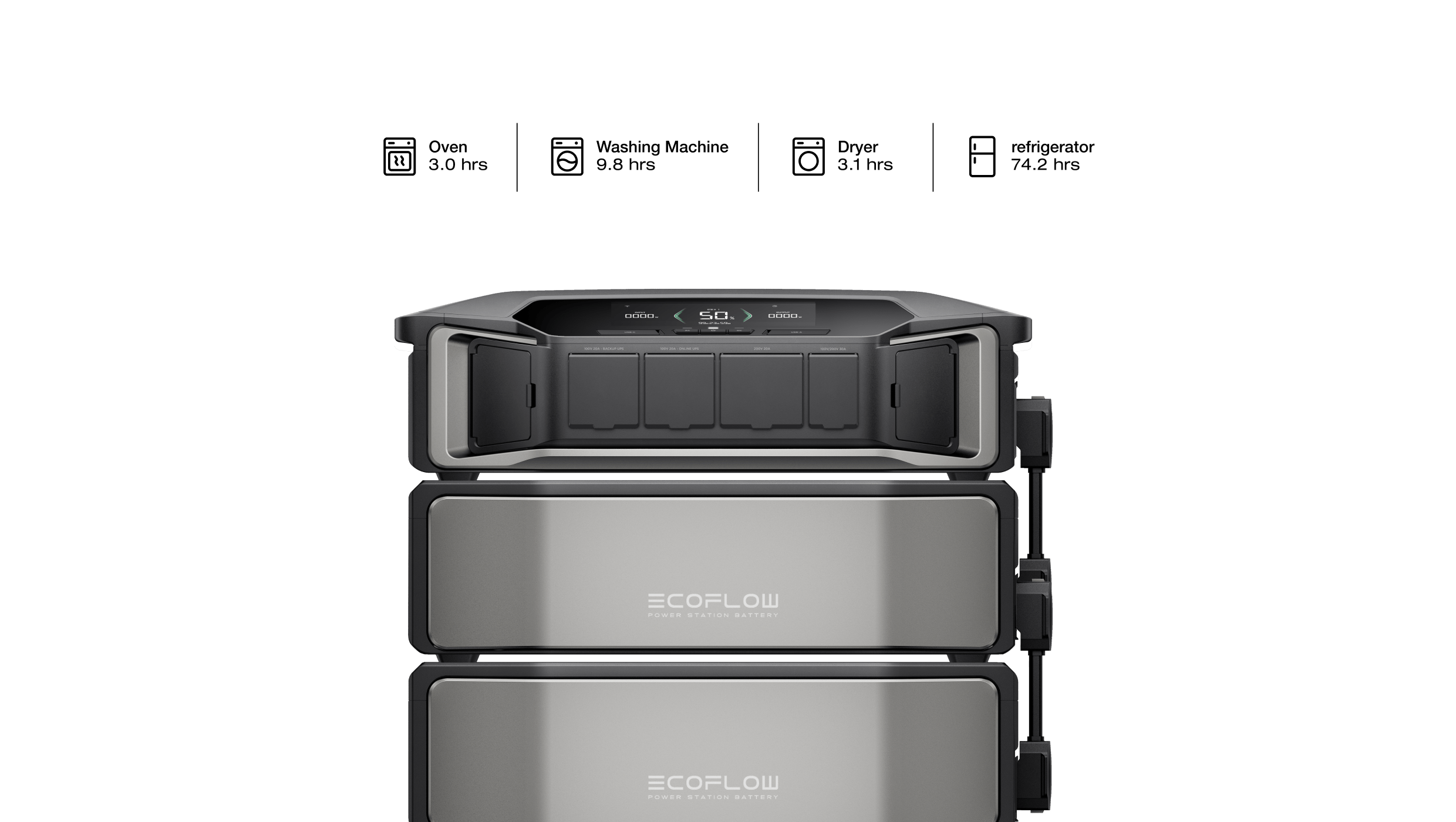
The EcoFlow Delta Pro Ultra is not a portable power station. Let's get that out of the way immediately. At 170 pounds for the inverter plus one battery, this is not something you are taking camping or loading into an RV for a weekend trip. What it is, however, is the most serious modular home battery system available from any portable power station manufacturer — a product that directly competes with permanently installed systems like the Tesla Powerwall 3 and Enphase IQ Battery.
The core concept is simple: one inverter unit paired with stackable 6,144Wh LFP battery modules. Start with one inverter and one battery for $4,099. Add more batteries as your budget allows, up to 5 batteries per inverter (30,720Wh). Need even more? Daisy-chain up to 3 inverters with 5 batteries each for a maximum system capacity of 90kWh and 21,600W of output. That is enough to run a large California home; including central air conditioning — for days during a PSPS event.
The key advantage over traditional home batteries: no permits, no electrician required for the basic setup, and you can take it with you if you move. The optional Smart Home Panel 2 does require professional installation if you want seamless whole-home automatic switchover, but the base system is genuinely plug-and-play.
Power Output & Expandability
A single Delta Pro Ultra inverter delivers 7,200W of continuous AC output. That is nearly double the 4,000W output of the Delta Pro 3 and meaningfully changes what you can power. A 7,200W continuous output can simultaneously run a refrigerator (~150W), several LED light circuits (~200W), a Wi-Fi router (~15W), a window AC unit (~1,200W), a microwave (~1,200W), and still have headroom for charging laptops and phones. In practical terms, it can keep an entire California home running on essential circuits without careful load management.
The 240V/30A L14-30 outlet is a significant differentiator. This is the same outlet type used for RV hookups and many home appliances, enabling you to power 240V loads like a well pump, a small central AC compressor, or an electric dryer — something most portable power stations simply cannot do. With 3 inverters (21,600W), you have enough output to rival a whole-home standby generator.
The expandability is where the Delta Pro Ultra truly separates itself from every competitor in this space. Here's how the math works:
Expandability Configurations
For most California homeowners, the practical sweet spot is 1 inverter with 2-3 batteries (12,288-18,432Wh). That provides enough capacity to ride out a 24-48 hour PSPS shutoff while running essential loads, and fits comfortably in a garage corner. The maximum 90kWh configuration is more relevant for off-grid homes, small businesses, or properties in extreme fire-risk zones where multi-day outages are routine.
Solar Charging
The Delta Pro Ultra accepts up to 5,600W of solar input via its built-in MPPT controller, more than double the 2,600W input of the Delta Pro 3. This is a critical specification for California homeowners who want to pair the system with rooftop or ground-mounted solar panels for true energy independence.
With 5,600W of solar input capacity and California's average 5-6 peak sun hours, you can theoretically push 28,000-33,600Wh of solar energy into the system per day, enough to fully recharge a 3-battery configuration (18,432Wh) every day with surplus. Even with real-world derating (clouds, panel angle, heat losses), a well-sized solar array can keep the Delta Pro Ultra topped off indefinitely during extended outages.
For practical sizing: fourteen 400W panels would give you approximately 5,600W of nameplate capacity, with real-world output around 4,000-4,500W during peak hours. That is a full recharge of a single 6,144Wh battery in roughly 1.5 hours of direct sun. If you already have rooftop solar, the Delta Pro Ultra can serve as your battery storage layer — though you will need compatible wiring and potentially the Smart Home Panel 2 for seamless integration.
Battery Technology: LFP Built for the Long Haul
Like all of EcoFlow's current flagship products, the Delta Pro Ultra uses LiFePO4 (LFP) battery chemistry. This is the same chemistry used in Tesla Powerwall, BYD Blade batteries, and most modern utility-scale storage installations. The advantages over older NMC (nickel manganese cobalt) chemistry are significant: LFP is more thermally stable (critical in a garage that hits 120°F in a California summer), does not suffer from thermal runaway, and lasts substantially longer.
EcoFlow rates the batteries at 3,500+ cycles to 80% capacity. If you cycle one battery per day (aggressive for most use cases), that translates to roughly 10 years before noticeable degradation. For the typical California homeowner using it primarily for outage backup and occasional TOU arbitrage (maybe 100-150 cycles per year), the batteries should retain 80%+ capacity for 20+ years. This longevity makes the cost-per-cycle math increasingly favorable over time.
Each battery module includes its own BMS (battery management system) that communicates with the inverter for balanced charging, temperature management, and cell-level monitoring. The EcoFlow app provides real-time visibility into each battery's health, cycle count, and temperature — a level of transparency that most permanently installed home batteries do not offer.
Smart Home Panel 2 Integration
The optional EcoFlow Smart Home Panel 2 is what transforms the Delta Pro Ultra from a very large battery with outlets into a genuine whole-home backup system. The Smart Home Panel 2 is a sub-panel that wires into your main electrical panel and manages up to 6 circuits. When grid power drops, it automatically switches those circuits to the Delta Pro Ultra within 10 milliseconds, fast enough that your refrigerator, sump pump, and internet router never even notice the transition.
The panel also enables intelligent load management through the EcoFlow app. You can prioritize which circuits get power first, set schedules for TOU rate optimization (charge from the grid during off-peak hours, discharge during peak), and monitor per-circuit energy consumption. For California homeowners on PG&E, SCE, or SDG&E time-of-use plans — where peak rates can exceed 40-50 cents per kWh, this TOU arbitrage capability can meaningfully offset the system's cost over time.
Important caveat: the Smart Home Panel 2 requires professional installation by a licensed electrician. This adds $500-$1,500 to the total cost depending on your panel's complexity and local labor rates. It is the one component of the Delta Pro Ultra system that is not DIY. However, even without the Smart Home Panel 2, the base system is fully functional — you just need to manually plug appliances into the inverter's outlets during an outage rather than having automatic switchover.
Ready to buy?
A compelling alternative to Tesla Powerwall at a fraction of the installed cost.
Delta Pro Ultra vs Delta Pro 3: Which One Do You Need?
This is the question most EcoFlow shoppers are asking, and the answer depends entirely on your use case. The Delta Pro 3 is a portable power station that happens to be powerful enough for home backup. The Delta Pro Ultra is a home battery system that happens to be modular and movable.
| Spec | Delta Pro Ultra | Delta Pro 3 |
|---|---|---|
| Base Capacity | 6,144Wh | 4,096Wh |
| Max Capacity | 90,000Wh (15 batteries) | 12,288Wh (3 batteries) |
| AC Output | 7,200W (up to 21,600W) | 4,000W (7,200W surge) |
| Solar Input | 5,600W | 2,600W |
| 240V Output | Yes (L14-30) | No |
| Weight | ~170 lbs | 114 lbs |
| UPS Switchover | <10ms | <20ms |
| Price | $4,099 | $1,999 |
| Best For | Whole-home backup, off-grid | Home backup + portable use |
Choose the Delta Pro 3 if you want a versatile power station that can do home backup AND go on camping trips, RV adventures, or tailgates. Its 114-lb weight is heavy but manageable for one person with the built-in wheels, and $1,999 is a more accessible entry point.
Choose the Delta Pro Ultra if your primary goal is home backup and you want the capacity to scale. The 7,200W output, 240V capability, 5,600W solar input, and ability to expand to 90kWh make it a fundamentally different product — a stationary home battery system with modular flexibility.
Delta Pro Ultra vs Tesla Powerwall 3
This is the comparison that matters for anyone considering the Delta Pro Ultra as a serious home backup investment. The Tesla Powerwall 3 is the incumbent champion of residential battery storage — but it comes with significant trade-offs that the Delta Pro Ultra avoids.
Tesla Powerwall 3 vs EcoFlow Delta Pro Ultra
The Tesla Powerwall 3 wins on raw single-unit specs: 13.5kWh capacity and 11.5kW output in one sleek wall-mounted package. Its solar integration is seamless, especially if you already have Tesla solar panels or a Tesla Solar Roof. And its Storm Watch feature, which automatically pre-charges the battery when severe weather is forecasted, is genuinely clever.
But the Delta Pro Ultra has three decisive advantages. First, cost: a single Delta Pro Ultra at $4,099 costs a third of what a Powerwall 3 costs installed ($12,500-$16,500). Even a 3-battery Delta Pro Ultra system (~$10,000) provides 18,432Wh for roughly the installed cost of a single Powerwall. Second, flexibility: the Delta Pro Ultra requires no permits, no electrician (for the base setup), and can be relocated if you move. A Powerwall is a permanent fixture tied to one property. Third, scalability: the Delta Pro Ultra can grow from 6.1kWh to 90kWh as your needs and budget evolve. Adding a second Powerwall means another $12,000+ installation.
The Powerwall wins for homeowners who want a fully integrated, set-it-and-forget-it system with professional installation and utility grid integration. The Delta Pro Ultra wins for homeowners who value flexibility, lower upfront cost, DIY capability, and the ability to start small and scale up over time.
Installation & Setup
The base Delta Pro Ultra system (inverter + battery) is genuinely plug-and-play. Unbox the units, connect the battery to the inverter via the included cable, plug the inverter into a wall outlet to charge, and you have a working backup system. The entire process takes 30-45 minutes including unboxing. No tools, no electrician, no permits.
The EcoFlow app (iOS and Android) guides you through the initial setup, including Wi-Fi connection, firmware updates, and configuring your preferred charging schedule. The app interface is clean and responsive; EcoFlow has clearly invested heavily in software, and it shows. You can monitor real-time input/output, set charging limits (useful for battery longevity), configure TOU schedules, and check battery health from anywhere.
Adding the Smart Home Panel 2 for automatic whole-home switchover is a more involved process. It requires hardwiring into your main electrical panel, which means a licensed electrician and potentially local permits depending on your jurisdiction. Budget $500-$1,500 for installation on top of the panel's cost. Once installed, however, the system becomes fully automatic, grid power drops, the Delta Pro Ultra takes over within 10ms, and you may not even notice the transition.
Who the Delta Pro Ultra Is Best For
California Homeowners in Fire-Risk Zones
If you live in a PG&E, SCE, or SDG&E territory that experiences regular PSPS shutoffs, the Delta Pro Ultra is one of the most cost-effective ways to guarantee continuous power. A 2-3 battery configuration can keep essential circuits running for 2-4 days, and with solar panels, you can extend that indefinitely.
TOU Rate Arbitrage Seekers
California's time-of-use rates punish peak-hour consumption with rates exceeding 40-50 cents/kWh. The Delta Pro Ultra with Smart Home Panel 2 can charge from the grid (or solar) during off-peak hours and discharge during peak — potentially saving $50-$150/month depending on your usage patterns and rate plan.
Solar Panel Owners Without Battery Storage
If you have rooftop solar but no battery, the Delta Pro Ultra's 5,600W solar input lets you capture and store daytime generation for evening use. Under NEM 3.0, where export credits have dropped significantly, storing your own solar energy for self-consumption is increasingly valuable.
Homeowners Who Want to Start Small and Scale
Unlike a Tesla Powerwall where you are committing $12,500+ upfront, the Delta Pro Ultra lets you start with one $4,099 unit and add capacity as your budget allows. This modular approach means you can have backup power this month and expand to whole-home coverage over the next year or two.
Pros & Cons
Pros
- Massive expandability: 6.1kWh to 90kWh
- 7,200W continuous output (21,600W with 3 inverters)
- 240V output for well pumps and large appliances
- 5,600W solar input, serious off-grid capability
- LFP battery: 3,500+ cycles, safe, long-lasting
- No permits required for base system
- <10ms UPS switchover
- Excellent app with energy management features
- Relocatable, take it with you if you move
Cons
- Heavy: 170 lbs. Not portable at all
- $4,099 entry price is steep for basic backup
- Smart Home Panel 2 requires professional install
- AC charging slower than Delta Pro 3 (2.5h vs 70min)
- Scaling to full capacity gets very expensive
- Large footprint, needs garage or utility room space
- No built-in wheels, need two people to move
Final Verdict
GreenReviewsHub Rating
The EcoFlow Delta Pro Ultra is the most ambitious product in the portable-adjacent power station category. It is not really portable, and that is fine, it is not trying to be. What it offers is something no other product in this space does: a modular, permit-free, relocatable home battery system that can scale from a modest 6.1kWh backup to a 90kWh whole-home powerhouse that rivals utility-scale installations.
For California homeowners, the value proposition is particularly strong. Between PSPS shutoffs that can last 3-5 days, TOU rates that punish peak-hour consumption, and NEM 3.0 making solar self-consumption more valuable than ever, the case for home battery storage is compelling. The Delta Pro Ultra delivers that storage at a significantly lower cost than Tesla Powerwall, with the added benefits of modularity and portability.
At $4,099, it is an investment — but it is an investment in energy independence that will pay dividends every time the grid goes down and your neighbors are in the dark while your lights stay on.
Frequently Asked Questions
How long can the EcoFlow Delta Pro Ultra power a whole house?
With a single 6,144Wh battery, the Delta Pro Ultra can run essential circuits (refrigerator, lights, Wi-Fi, phone chargers) for approximately 2 days. Expanding to the maximum 90kWh configuration with 15 batteries could power essential loads for 2+ weeks, or run a full home including HVAC for several days.
Is the EcoFlow Delta Pro Ultra better than Tesla Powerwall 3?
They serve different needs. The Delta Pro Ultra is modular, requires no permits, and can be self-installed. The Powerwall 3 ($12,500-$16,500 installed) integrates more seamlessly with rooftop solar but is a permanent installation. The Delta Pro Ultra wins on flexibility and upfront cost; the Powerwall wins on seamless grid integration.
Can the Delta Pro Ultra charge from solar panels?
Yes. It accepts up to 5,600W of solar input — one of the highest in any consumer battery system. With a well-sized panel array in California, you can fully recharge a single battery in about 1.5 hours of direct sun.
Does the Delta Pro Ultra require professional installation?
The base system (inverter + batteries) is plug-and-play. no electrician or permits needed. The optional Smart Home Panel 2 for automatic whole-home switchover does require professional installation by a licensed electrician.
Is the Delta Pro Ultra eligible for California SGIP rebates?
Potentially. SGIP offers $150/kWh for general market customers (~$922 for the 6.144kWh unit) and up to $1,100/kWh for equity customers in high fire-threat districts. Eligibility depends on your utility territory and application timing.
How much does a full 90kWh system cost?
A maximum configuration (3 inverters + 15 batteries) runs roughly $40,000-$50,000. Most homeowners will find the sweet spot at 1 inverter + 2-3 batteries ($7,000-$10,000), which provides 12-18kWh of storage for 1-2 days of essential-circuit backup.
Final Verdict
Ready to Order the EcoFlow?
Whole-home backup with the modularity of a portable system — a compelling alternative to permanent Powerwall installs.
We may earn a commission at no extra cost to you. Prices verified October 2026.
Still comparing?
See how the Delta Pro Ultra stacks up against other top-rated power stations and home batteries.
Browse All Reviews