Best Tankless Water Heaters (2026): Rinnai vs Rheem vs Navien vs Noritz
We may earn a commission on qualifying purchases through links on this page, at no extra cost to you. Our recommendations are based on independent research — manufacturer specifications, independent lab data, and aggregated owner reports — not on commission rates.
Your water heater accounts for roughly 20% of your home's energy bill — second only to heating and cooling. If you're still running a traditional tank heater, you're paying to keep 40-50 gallons of water hot 24 hours a day, whether you use it or not. Tankless water heaters solve that by heating water on demand, cutting energy waste by 24-34% and lasting twice as long.
We spent over 80 hours researching flow rates, efficiency ratings, installation requirements, and real-world owner feedback to find the best tankless water heaters for every budget and household size. Whether you need a powerhouse for a 4-bathroom home or a compact unit for a small condo, this guide has you covered.
All five of our picks are gas-fired condensing or non-condensing models, which deliver the high flow rates (6.5-11+ GPM) needed for whole-home use. We also cover gas vs. Electric, sizing by household, and a full cost breakdown so you can make an informed decision.
Quick Picks: Our Top 5
Rinnai RU199iN — Best Overall
$1,800-$2,200 · 11 GPM · 0.96 UEF · 15-yr heat exchanger
Rheem RTGH-95DVLN — Best Value
$1,200-$1,500 · 9.5 GPM · 0.93 UEF · 12-yr heat exchanger
Navien NPE-240A2 — Most Efficient
$1,600-$2,000 · 11.2 GPM · 0.96 UEF · 15-yr heat exchanger
Noritz EZ111DV — Best Compact
$1,300-$1,600 · 11.1 GPM · 0.97 UEF · 12-yr heat exchanger
Rinnai V65iN — Best Budget
$700-$900 · 6.5 GPM · 0.82 UEF · 10-yr heat exchanger
Full Comparison Table
| Model | Price | BTU | GPM | UEF | Warranty | Rating |
|---|---|---|---|---|---|---|
Rinnai RU199iN Best Overall | $1,800-$2,200 | 199,000 | 11 | 0.96 | 15-yr heat exchanger | 4.7/5 |
Rheem RTGH-95DVLN Best Value | $1,200-$1,500 | 199,000 | 9.5 | 0.93 | 12-yr heat exchanger | 4.5/5 |
Navien NPE-240A2 Most Efficient | $1,600-$2,000 | 199,000 | 11.2 | 0.96 | 15-yr heat exchanger | 4.6/5 |
Noritz EZ111DV Best Compact | $1,300-$1,600 | 199,000 | 11.1 | 0.97 | 12-yr heat exchanger | 4.4/5 |
Rinnai V65iN Best Budget | $700-$900 | 150,000 | 6.5 | 0.82 | 10-yr heat exchanger | 4.3/5 |
How Tankless Water Heaters Work
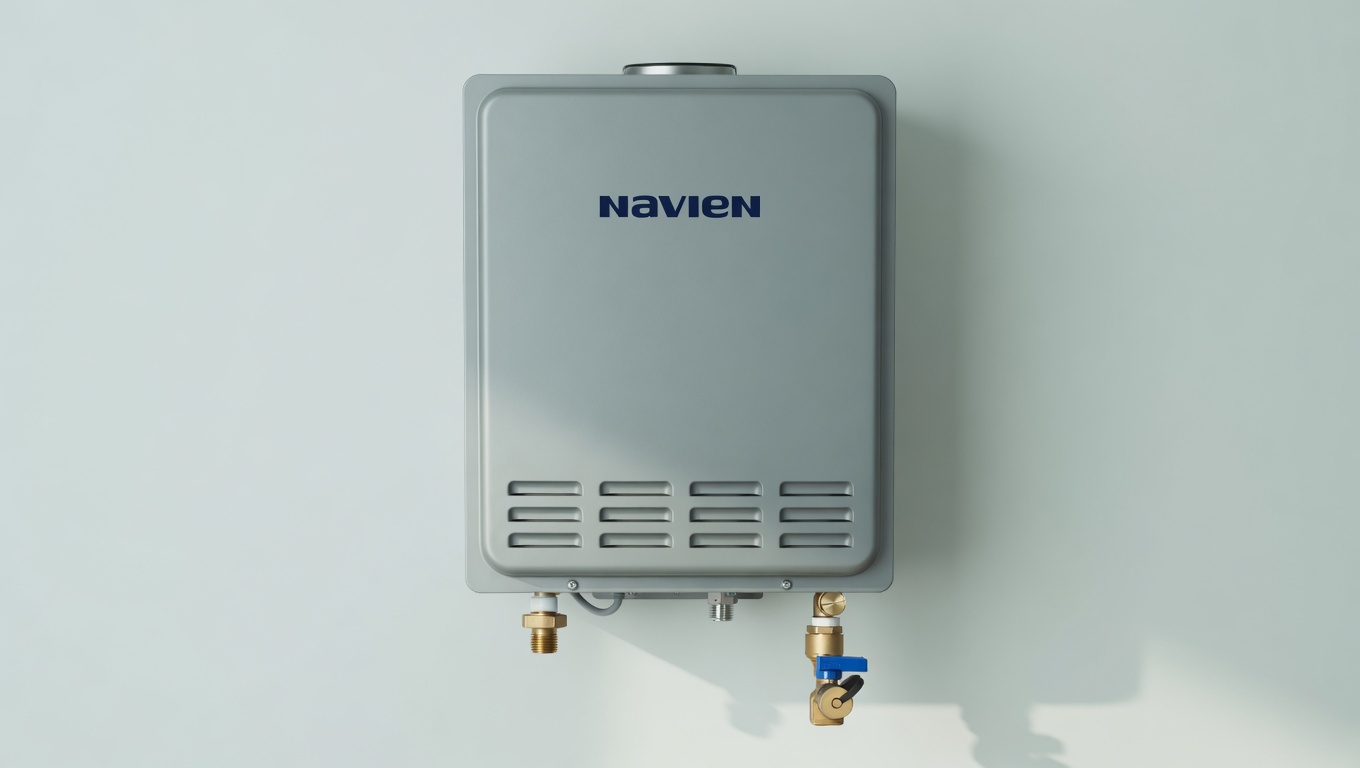
Unlike traditional tank water heaters that store and continuously heat 40-80 gallons of water, tankless units heat water only when you turn on a faucet. When a hot water tap opens, cold water flows through a pipe into the unit, and either a gas burner or electric element heats it instantly.
The Tankless Process, Step by Step
- 1You open a hot water tap. A flow sensor inside the unit detects water movement.
- 2The control board ignites the gas burner (or activates the electric element). A 199,000 BTU gas burner can raise water temperature by 70+ degrees F at 8-11 GPM.
- 3Cold water passes through the heat exchanger — a series of copper or stainless steel coils heated by the burner. It exits at your set temperature (typically 120 degrees F).
- 4Hot water flows to your faucet, shower, or appliance. When you close the tap, the unit shuts off. No energy is used between draws.
Condensing vs. Non-condensing: Condensing units (like the Rinnai RU199iN and Navien NPE-240A2) capture heat from exhaust gases through a secondary heat exchanger, achieving UEF ratings of 0.93-0.97. Non-condensing units vent that heat outside, resulting in slightly lower efficiency (0.80-0.85) but simpler venting with standard stainless steel vent pipes.
Recirculation systems: Some models like the Navien NPE-240A2 include a built-in recirculation pump that keeps a small loop of water warm so you get hot water almost instantly at the tap — eliminating the typical 15-30 second "cold water sandwich" that some tankless units are known for.
Cost Breakdown: Unit + Installation + Savings
The biggest objection to tankless water heaters is the upfront cost. Let's break down what you're actually paying — and what you save over time.
| Cost Category | Tank Heater | Tankless (Budget) | Tankless (Premium) |
|---|---|---|---|
| Unit cost | $400-$800 | $700-$900 | $1,800-$2,200 |
| Installation | $500-$1,000 | $1,500-$2,000 | $2,000-$3,000 |
| Total installed | $900-$1,800 | $2,200-$2,900 | $3,800-$5,200 |
| Annual energy cost | $350-$500/yr | $250-$350/yr | $200-$300/yr |
| Expected lifespan | 10-12 years | 15-20 years | 20-25 years |
| Lifetime energy cost | $3,500-$6,000 | $3,750-$7,000 | $4,000-$7,500 |
| Total cost of ownership | $4,400-$7,800 | $5,950-$9,900 | $7,800-$12,700 |
The Real Savings Math
A typical household saves $100-$150 per year on energy with a tankless unit. But the bigger savings come from longevity: you'll likely replace a tank heater twice in the time a single tankless unit lasts. Factor in two tank replacements ($1,800-$3,600) and the tankless unit often comes out ahead over 20 years — while providing unlimited hot water and taking up far less space.
Tankless vs. Tank Water Heaters
Tankless Advantages
- Unlimited hot water on demand
- 24-34% more energy efficient
- 20-25 year lifespan (vs 10-12)
- Compact wall-mount saves floor space
- No risk of 40-gallon flood from a burst tank
- Lower monthly energy bills
- Cleaner water (no sediment buildup in tank)
Tank Advantages
- Lower upfront cost ($900-$1,800 installed)
- Simpler installation (direct swap)
- Works during power outages (gas tank)
- No minimum flow rate requirement
- Familiar technology, easy to find plumbers
- No "cold water sandwich" issue
- Better for homes with very high simultaneous demand
Sizing Guide: What GPM Do You Need?
GPM (gallons per minute) is the most important spec when choosing a tankless water heater. You need enough flow rate to handle your peak simultaneous hot water usage. Here's how to figure it out:
Typical Flow Rates by Fixture
| Fixture | Flow Rate |
|---|---|
| Shower | 2.0-2.5 GPM |
| Bathroom faucet | 0.5-1.5 GPM |
| Kitchen faucet | 1.0-1.5 GPM |
| Dishwasher | 1.0-1.5 GPM |
| Washing machine | 1.5-3.0 GPM |
Recommended GPM by Household Size
Our pick: Rinnai V65iN (6.5 GPM)
Handles one shower + one faucet simultaneously
Our pick: Rheem RTGH-95DVLN (9.5 GPM)
Two showers running at the same time with headroom
Our pick: Rinnai RU199iN (11 GPM) or Navien NPE-240A2 (11.2 GPM)
Three showers plus a dishwasher without breaking a sweat
Our pick: Two Rinnai RU199iN units in parallel
For homes with very high simultaneous demand, two units in a manifold setup is common
Gas vs. Electric Tankless Water Heaters
This is one of the most common questions we get, and the answer is straightforward for most households: gas wins for whole-home use, electric wins for point-of-use.
| Factor | Gas Tankless | Electric Tankless |
|---|---|---|
| Flow rate | 8-11+ GPM | 2-5 GPM |
| Best for | Whole-home | Single fixture/point-of-use |
| Unit cost | $700-$2,200 | $200-$800 |
| Installation cost | $1,500-$3,000 | $500-$1,500 |
| Requires venting | Yes (PVC for condensing) | No |
| Requires gas line | Yes (3/4" minimum) | No |
| Electrical needs | Standard 120V outlet | 200A panel, dedicated breaker |
| Energy efficiency | 0.82-0.97 UEF | 0.95-0.99 UEF |
| Operating cost | Lower (natural gas cheaper) | Higher (electricity rates) |
Bottom line: If you have a natural gas line and want to replace your whole-home water heater, go gas. Electric tankless units are excellent for adding hot water to a specific location — like an outdoor shower, a garage sink, or a guest bathroom far from the main water heater — but they can't match the flow rates needed for a whole home.
Rinnai RU199iN
$1,800-$2,200 · 199K BTU · 11 GPM · 0.96 UEF
The Rinnai RU199iN is the gold standard in residential tankless water heaters. It's a condensing unit with a 0.96 UEF rating, meaning 96 cents of every dollar spent on gas goes directly to heating water. At 11 GPM, it can comfortably supply three simultaneous showers plus a dishwasher in warm climates.
The built-in Wi-Fi module lets you monitor performance, adjust temperature, and receive maintenance alerts through the Rinnai app. The 15-year heat exchanger warranty is the best in the industry, and Rinnai's service network is the largest in North America — important when you need parts or a technician.
The main drawback is price. At $1,800-$2,200 for the unit alone plus $2,000-$3,000 for professional installation, you're looking at a $4,000-$5,200 total investment. But with a 20-25 year lifespan and $100-$150 in annual energy savings, the math works out in the long run.
Pros
- Industry-leading 0.96 UEF efficiency
- Wi-Fi monitoring and app control
- 15-year heat exchanger warranty
- 11 GPM handles large homes easily
- Largest service network in North America
- Compatible with recirculation systems
Cons
- Highest unit price in our lineup
- Installation often requires gas line upgrade
- No built-in recirculation pump (add-on)
Rheem RTGH-95DVLN
$1,200-$1,500 · 199K BTU · 9.5 GPM · 0.93 UEF
The Rheem RTGH-95DVLN hits a sweet spot between performance and price. At $1,200-$1,500 for the unit, it's $600-$700 less than the Rinnai while still delivering 199K BTU and 9.5 GPM — enough for a 2-3 bathroom home running two showers simultaneously.
The 0.93 UEF condensing efficiency is slightly below Rinnai's 0.96, but in practice the difference amounts to roughly $10-$15 per year in gas costs. The built-in EcoNet Wi-Fi module provides similar app-based monitoring. Where it falls short is the 12-year heat exchanger warranty (vs. 15 for Rinnai) and lower flow rate.
For the vast majority of 2-3 bedroom homes, this is the unit we recommend. The performance-per-dollar ratio is unmatched, and Rheem's parts availability is excellent at Home Depot and most plumbing supply houses nationwide.
Pros
- Best price-to-performance ratio
- 0.93 UEF condensing efficiency
- Built-in EcoNet Wi-Fi monitoring
- Parts widely available (Home Depot, etc.)
- 9.5 GPM covers most homes
- Low NOx emissions (SCAQMD compliant)
Cons
- 12-year warranty (vs 15 for Rinnai/Navien)
- 9.5 GPM may be tight for 4+ bathroom homes
- No built-in recirculation pump
Noritz EZ111DV
$1,300-$1,600 · 199K BTU · 11.1 GPM · 0.97 UEF
The Noritz EZ111DV earns its "Best Compact" badge with the smallest footprint in our lineup while still packing 199K BTU and 11.1 GPM. At 0.97 UEF, it's technically the most efficient unit in this guide — though the real-world difference between 0.96 and 0.97 is negligible.
Noritz designed the EZ series specifically for easy replacement of existing tankless units. The "EZ" in the name refers to its simplified installation: dual direct-vent capability and compact dimensions that fit into tight spaces where other units won't. This makes it an excellent choice for condos, townhomes, or utility closets.
The 12-year heat exchanger warranty is solid but trails Rinnai and Navien's 15-year coverage. Noritz is a Japanese manufacturer with a strong reputation in Asia but a smaller brand presence in the US, which can make finding authorized service technicians slightly harder in some areas.
Pros
- Highest UEF at 0.97 (most efficient)
- Most compact footprint in category
- 11.1 GPM rivals the Rinnai and Navien
- Designed for easy replacement installs
- Dual direct-vent capable
- Competitive mid-range pricing
Cons
- Smaller US service network
- 12-year warranty (vs 15 for Rinnai/Navien)
- No built-in Wi-Fi or recirculation pump
Rinnai V65iN
$700-$900 · 150K BTU · 6.5 GPM · 0.82 UEF
The Rinnai V65iN proves you don't need to spend $2,000+ to go tankless. At $700-$900, it's less than half the price of the RU199iN and still carries the Rinnai name, quality, and service network. The tradeoff is a non-condensing design (0.82 UEF), lower BTU output (150K), and 6.5 GPM flow rate.
For a 1-2 bathroom home — or a condo, guest house, or small rental property — 6.5 GPM is plenty. It handles one shower and one sink running simultaneously without issues. In warmer climates where groundwater temperatures are higher, effective GPM increases since the unit needs to heat water by fewer degrees.
The non-condensing design actually simplifies installation: it uses standard stainless steel vent pipe instead of the special PVC venting that condensing units require. This can save $300-$500 on installation costs. Total installed cost runs $2,200-$2,900, making it competitive with high-end tank water heaters.
Pros
- Lowest price for a quality tankless unit
- Rinnai brand reliability and service network
- Simpler installation (non-condensing venting)
- Perfect for 1-2 bathroom homes
- 10-year heat exchanger warranty
- Compact indoor-mount design
Cons
- 6.5 GPM limits simultaneous use
- 0.82 UEF is lowest in our lineup
- No Wi-Fi, no recirculation
- Non-condensing = higher exhaust temps
Installation Considerations
Tankless water heater installation is more involved than a simple tank swap. Here's what to expect and budget for:
Gas Line Upgrade
$200-$800Most tankless units require a 3/4" gas line. If your home has a 1/2" line (common in older homes), it needs to be upgraded. This is the most common hidden installation cost.
Venting
$300-$1,000Condensing units (Rinnai RU199iN, Rheem, Navien, Noritz) use PVC venting, which is cheaper. Non-condensing units (Rinnai V65iN) require stainless steel Category III vent pipe. If the unit is far from an exterior wall, venting costs increase.
Electrical
$100-$300Gas tankless units still need a 120V outlet for the control board and ignition. If there is no outlet near the installation location, an electrician will need to run one.
Water Line Modifications
$100-$400The inlet and outlet connections may need to be rerouted, especially when switching from a floor-standing tank to a wall-mounted tankless unit in a different location.
Permits
$50-$200Most municipalities require a plumbing permit for water heater replacement. Some also require a gas permit if the gas line is being modified. Your installer should handle this.
Condensate Drain
$50-$200Condensing units produce acidic condensate that must be drained. If the unit is installed in a location without a floor drain, a condensate pump or drain line must be added.
Pro Tip: Get 3 Quotes
Installation costs vary significantly by region and contractor. Always get at least three written quotes. Ask specifically about gas line upgrades, venting materials, and whether permits are included in the price. A reputable installer will inspect your gas line, electrical, and venting before giving a final quote.
Pros and Cons of Going Tankless
Pros
- Unlimited hot water, never runs out mid-shower
- 24-34% more energy efficient than tank heaters
- Lasts 20-25 years (double a tank heater)
- Wall-mounted design frees up floor space
- $100-$150 annual energy savings
- No risk of catastrophic tank failure and flooding
- Cleaner water without sediment buildup
- Lower carbon footprint due to reduced gas usage
- Compatible with solar thermal pre-heating
- Higher resale value for your home
Cons
- Higher upfront cost ($2,200-$5,200 installed)
- Installation is more complex than tank swap
- May require gas line and venting upgrades
- Slight delay before hot water arrives (without recirc pump)
- Minimum flow rate required to activate the burner
- Annual descaling maintenance recommended
- Electric models are limited to point-of-use
- Not ideal during power outages (needs electricity)
- Hard water areas require more frequent maintenance
- Larger homes may need two units in parallel
Frequently Asked Questions
How much does a tankless water heater cost installed?
A tankless water heater typically costs $700 to $2,200 for the unit itself, plus $1,500 to $3,000 for professional installation. Total installed cost ranges from $2,200 to $5,200 depending on the model, whether you need gas line upgrades, and venting requirements. High-efficiency condensing units like the Rinnai RU199iN or Navien NPE-240A2 are at the higher end but deliver better long-term savings.
Is a tankless water heater worth the investment?
Yes, for most homes. Tankless water heaters are 24-34% more energy efficient than traditional tank heaters for homes using 41 gallons or less per day. They last 20+ years versus 10-12 for tank heaters, provide unlimited hot water on demand, and save $100-$150 per year on energy bills. The higher upfront cost is typically recouped within 6-10 years.
What size tankless water heater do I need for my home?
Sizing depends on flow rate (GPM) needs. A 1-2 bathroom home needs 6-8 GPM. A 2-3 bathroom home needs 8-10 GPM. A 3+ bathroom home needs 10-12 GPM. In warm climates like California, groundwater is warmer (around 62 degrees F), so a given unit can deliver higher flow rates than in colder regions. The Rinnai RU199iN at 11 GPM handles most homes comfortably.
How long does a tankless water heater last?
Tankless water heaters typically last 20-25 years with proper maintenance, roughly double the 10-12 year lifespan of traditional tank water heaters. Most manufacturers offer 12-15 year heat exchanger warranties. Annual descaling is recommended, especially in areas with hard water, to maintain peak efficiency and extend lifespan.
Gas vs electric tankless water heater: which is better?
Gas tankless heaters deliver significantly higher flow rates (8-11+ GPM) compared to electric units (2-5 GPM), making gas the better choice for whole-home use. Electric tankless units are simpler to install and work well for single-point use (one shower or sink). For a household with multiple bathrooms, a gas tankless unit is almost always the right choice.
Do tankless water heaters work with solar water heating?
Yes. Many tankless water heaters can accept pre-heated water from solar thermal systems. Units like the Navien NPE-240A2 with recirculation pumps are particularly compatible. The tankless unit acts as a backup, only firing when the solar-preheated water needs a temperature boost. This combination can reduce water heating energy use by 50-80%.
Final Verdict
There is no single "best" tankless water heater — it depends on your household size, budget, and priorities. Here is our quick decision framework:
If you want the best reliability, warranty, and service network with top-tier efficiency, this is the one to buy. Ideal for 3+ bathroom homes.
The sweet spot for most 2-3 bathroom homes. You get 90%+ of the Rinnai's performance at 60-70% of the price.
If instant hot water matters to you, the built-in recirculation pump is a game-changer. Best pick for homes where the water heater is far from the bathrooms.
Tight on space? The Noritz packs flagship-level specs into the smallest footprint. Great for condos and townhomes.
The smartest entry point into tankless. Perfect for small homes, condos, guest houses, or rental properties where 6.5 GPM is sufficient.
Whichever model you choose, upgrading from a traditional tank to a tankless water heater is one of the highest-ROI home improvements you can make. You'll save on energy every month, never run out of hot water, and have a unit that lasts two decades or more.
Pairing with solar? If you're considering a tankless water heater alongside rooftop solar panels, the energy savings compound. Solar offsets your electricity costs while the tankless unit cuts your gas bill. Combined, many California homeowners see 40-60% reductions in total utility costs. Browse more energy-saving product reviews to see how the pieces fit together.
Explore More Reviews
We review the best energy-efficient products for your home — from portable power stations to solar equipment and beyond.
View All Reviews